

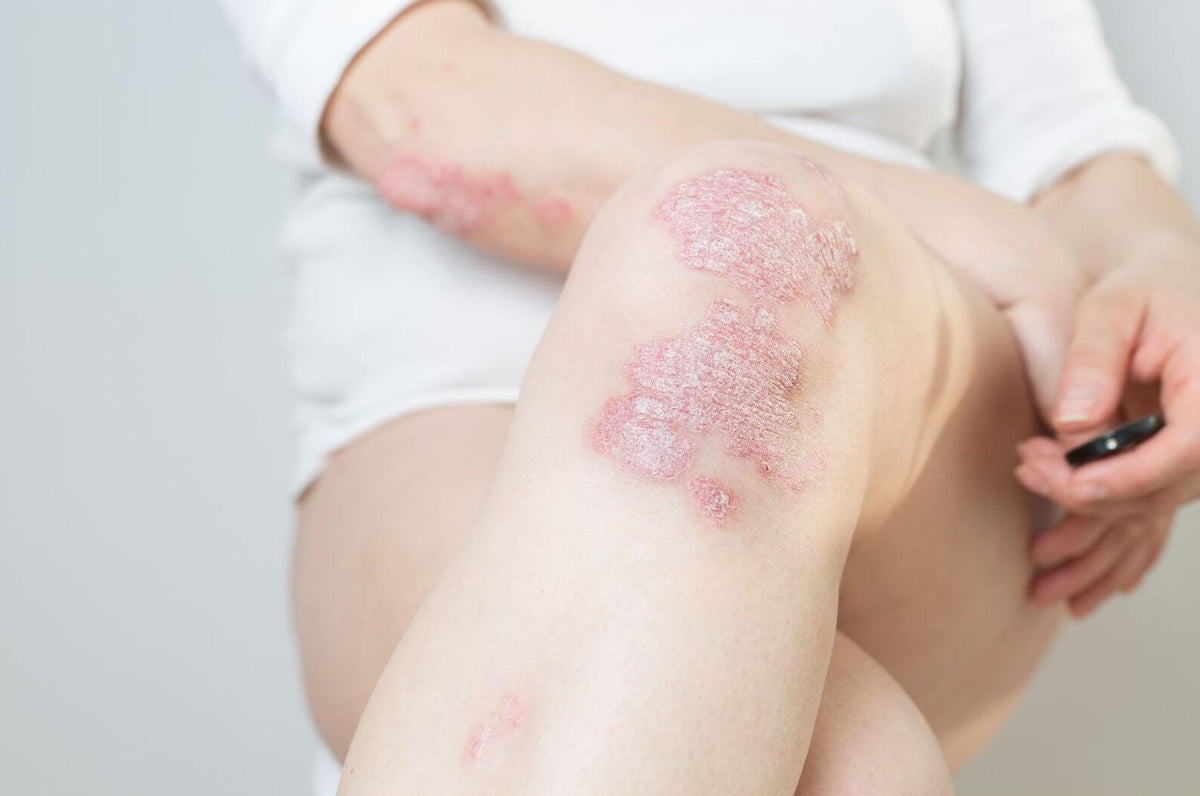
CBD for Psoriasis
|
|
Time to read 8 min
Kostenlose Lieferung ab 59€ 🚚
|
|
Time to read 8 min
Psoriasis is one of the most common skin diseases worldwide. It is characterized by red, itchy, and painful skin patches that affect much more than just the skin. Psoriasis often impacts overall quality of life, leading to persistent discomfort, social isolation, and emotional distress. While conventional treatment methods often provide only short-term relief and carry the risk of side effects, many sufferers are seeking alternative, natural therapies.
In this context, CBD (cannabidiol) from the cannabis plant is gaining importance due to its immunomodulatory, anti-inflammatory, and pain-relieving properties. Our article is based on the latest scientific findings and demonstrates the potential of CBD as a natural treatment option that specifically targets the causes and symptoms of psoriasis.
Join us to discover the causes, symptoms, and traditional treatment methods for psoriasis, and learn how CBD can play a role in therapy, including practical application tips and advice for managing the condition.
Table of Contents
Psoriasis is a long-term, non-contagious skin disease whose symptoms occur in flare-ups. Sufferers often experience periods with few to no symptoms, followed by outbreaks where symptoms intensify. Psoriasis is primarily known for its skin manifestations – the formation of red, scaly plaques that can itch and hurt. These skin changes result from an overproduction of skin cells, leading to skin thickening and characteristic scaling.
The exact causes of psoriasis are complex and involve a combination of genetic, immunological, and environmental factors. At the core of the disease is an overactive immune system, which leads to accelerated cell production. Genetic predisposition also plays a role. People with family members who suffer from psoriasis have an increased risk of developing it themselves. Triggers such as stress, skin injuries, certain medications, and infections can also lead to outbreaks.
The symptoms of psoriasis vary depending on the type and severity of the disease. The most common features include:
Although there is no cure for psoriasis, treatment options aim to alleviate symptoms and improve the quality of life for those affected. Traditional treatment methods include topical treatments such as steroid creams, light therapy, and systemic medications that target the immune system. However, these methods can have side effects and are not effective for all patients, which encourages the search for alternative treatment options. Against this background, CBD is gaining increasing importance.
CBD is one of over 100 compounds found in the cannabis plant. Unlike THC (tetrahydrocannabinol), the psychoactive component of cannabis, CBD has no intoxicating effects. CBD is valued for its potential therapeutic properties, including its anti-inflammatory, pain-relieving, and immunomodulatory effects.
The potential benefits of CBD for psoriasis are diverse. CBD interacts with our body's endocannabinoid system (ECS). The ECS is an essential part of the human nervous system and plays a central role in regulating a variety of physiological processes and functions, including pain perception, inflammatory responses, and cell regeneration. CBD interacts with the ECS by binding to specific receptors, which can lead to potential therapeutic effects such as pain relief, reduction of inflammation, and promotion of skin health.
The interaction of CBD with the body's endocannabinoid system (ECS) shows significant potential in treating psoriasis by targeting both immune responses and the symptoms of the disease.
Firstly, CBD targets the overactivity of the immune system, which plays a key role in the development of psoriasis. By modulating the immune response, CBD can help to normalize the excessive production of skin cells, thereby directly addressing the root cause of the disease. This immunomodulatory effect forms the basis for the further therapeutic effects of CBD in psoriasis.
Building on its ability to dampen the immune response, CBD utilizes its pronounced anti-inflammatory properties to effectively alleviate redness and swelling. This direct reduction of inflammation is crucial for minimizing the visible symptoms of psoriasis and providing relief to affected individuals.
Finally, CBD offers significant pain-relieving effects, which are particularly important for individuals with painful psoriasis plaques. By fighting pain directly at the source, CBD serves as a natural alternative to traditional painkillers to reduce the itching and discomfort associated with the condition.
Through this comprehensive mode of action, which begins with immunomodulation and extends through anti-inflammatory effects to pain relief, CBD is establishing itself as a promising option in the treatment and management of psoriasis.
The use of CBD for psoriasis offers a wide range of possibilities to alleviate the symptoms of this skin condition. The choice of the right CBD products and their application methods depends on individual preferences and the specific needs of those affected. A detailed look at the different application methods can help to find the optimal strategy for treatment.
Topical products such as creams and ointments are known for their targeted effect. They allow for direct application to the affected skin areas, which makes them particularly effective in treating local symptoms such as inflammation and itching.
These products are formulated to penetrate deep into the skin and exert their anti-inflammatory and soothing properties there, without affecting the entire organism.
Another advantage is that they usually contain additional moisturizing ingredients that nourish and keep dry, cracked skin, which is common in psoriasis, supple.
Application tips:
For effective use, the affected skin area should first be gently cleaned and dried before applying a thin layer of CBD cream or ointment. Regular application can help to significantly relieve skin discomfort.
Product suggestion:
*Note
CBD facial cream can, of course, also be used for the body.
For systemic effects that go beyond local symptom relief, oral intake of CBD is an option. CBD oil, administered sublingually (under the tongue), can quickly enter the bloodstream and thus exert a comprehensive effect throughout the body. CBD capsules offer a discreet and easy way to consume CBD, with the advantage of precise dosing.
Application tips:
For sublingual use, the oil should be held under the tongue for about 60 seconds to ensure optimal absorption. The dosage can be adjusted gradually. It is best to start with a low dose to observe the body's individual reaction and adjust the dosage accordingly.
Product suggestion:
A combined application of topical and oral CBD products can represent a comprehensive strategy for the treatment of psoriasis. While topical products specifically address local symptoms, oral forms can reduce systemic inflammation in the body and contribute to general pain relief. This holistic approach can significantly improve the quality of life for those affected.
The selection and application of CBD products for psoriasis should always be done in consultation with a medical professional, especially if other medications are already being taken. An individually tailored treatment strategy that considers both specific symptoms and personal preferences is crucial for the success of the therapy.
Scientific research into CBD as a treatment option for psoriasis has already yielded some promising results. Studies suggest that CBD can indeed have a positive effect on psoriasis, with topically applied products such as ointments and creams being particularly effective. The use of CBD oil has also proven beneficial.
In a general study on cannabinoids and their influence on the immune system, it was found that CBD exerts a specific effect on the CB2 receptor in the endocannabinoid system.¹ A study conducted in 2014 provided concrete evidence for the efficacy of CBD in psoriasis. This research showed that CBD can inhibit cell growth and reduce the production of cytokines, proteins that play a role in inflammatory processes. By lowering cytokine levels, inflammation can be effectively alleviated.²
Further studies confirmed that the use of CBD-containing ointments can significantly reduce itching. Patients who applied a CBD ointment twice daily for two to three weeks reported a significant decrease in itching.
Research conducted as early as 2007 concluded that CBD and other cannabinoids have the potential to slow the growth of keratinocytes³ - a finding that could be of great importance for the treatment of psoriasis. The results of these studies underscore the potential role of CBD as a valuable treatment option for psoriasis.
In addition to the use of CBD, the following measures can also be helpful to holistically improve the quality of life for people with psoriasis:
With its immunomodulatory, anti-inflammatory, and pain-relieving properties, CBD proves to be a promising option for individuals suffering from psoriasis. CBD not only addresses the underlying causes of the disease but also effectively alleviates its symptoms, as numerous studies have shown.
Various CBD products can be chosen and combined for treatment. A combined application of topical and oral CBD products can be the optimal strategy to address both local and systemic symptoms of psoriasis. This holistic approach can significantly contribute to improving quality of life.
For successful application, it is important to discuss the use of CBD with a doctor, especially if other medications are being taken simultaneously. By choosing the right products and dosages, based on professional advice, CBD can become a valuable component of psoriasis treatment.
Sources and Studies
¹ S. Rieder, S.A. Amcaoglu et al.: Cannabinoid-induced apoptosis in immune cells as a pathway to immunosuppression. In: Immunobiology. Volume 215, Issue 8, 2010, pp. 598–605.
² A. Oláh, A. et al.: Cannabidiol exerts sebostatic and antiinflammatory effects on human sebocytes. In: The Journal of Clinical Investigation. Volume 124, Issue 9, 2014, pp. 3713–3724.
³ J.D. Wilkinson, E.M. Williamson: Cannabinoids inhibit human keratinocyte proliferation through a non-CB1/CB2 mechanism and have a potential therapeutic value in the treatment of psoriasis. In: Journal of Dermatological Science. Volume 45, Issue 2, 2007, pp. 87–92.

