

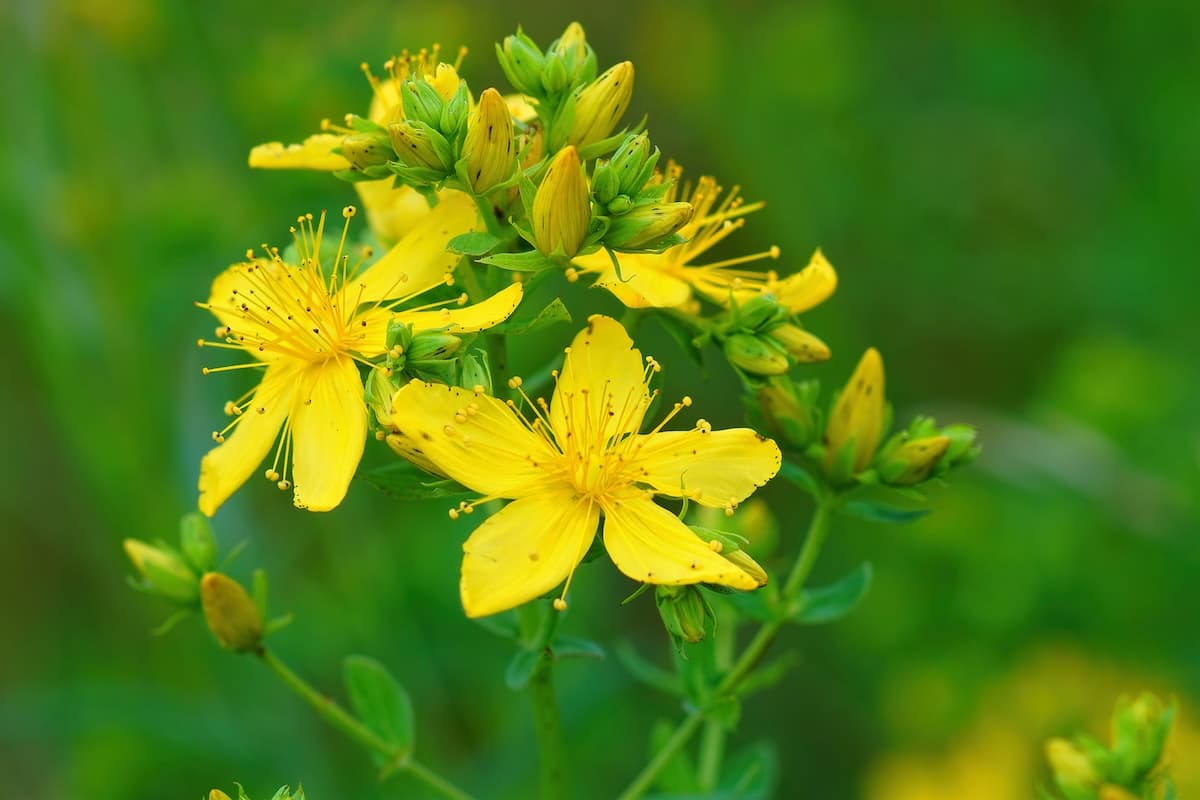
Taking St. John's wort and CBD together – Sounds good, but carries risks
|
Time to read 7 min
Free delivery on orders over €59 🚚
|
Time to read 7 min
St. John's wort is one of the most popular herbal remedies for low moods and mild depression. It is easily available over-the-counter in pharmacies or drugstores and is considered an ideal, natural way to improve well-being.
However: herbal in this case does not mean completely harmless. St. John's wort is a very potent active ingredient that can also interact with many different medications (e.g., blood thinners, antidepressants).
Many fans of natural active ingredients like St. John's wort are also interested in the positive effects of CBD (cannabidiol). This raises the question: Can the simultaneous intake of CBD and St. John's wort have negative effects? Or do the two even amplify each other's positive effects on sleep, stress, and well-being? Does CBD perhaps even counteract the side effects of St. John's wort?
We take a close look at the interactions between CBD and St. John's wort and clarify when the two work really well together, when caution is advised, and in which cases St. John's wort can even be an alternative to CBD.
Table of Contents
St. John's wort and CBD both affect the central nervous system and the metabolism of medications by the liver. This can lead to unwanted interactions.
St. John's wort can weaken the effect of many medications, while CBD sometimes strengthens them. If you are taking medications such as antidepressants, blood thinners, or hormonal contraceptives, you should therefore consult your doctor beforehand.
For many users, CBD can be a more tolerable alternative to St. John's wort - provided it contains as little THC as possible, is of high quality, and is taken with medical consultation if necessary.
St. John's wort (Hypericum perforatum) exerts its effect by inhibiting the reuptake of certain neurotransmitters, especially serotonin, norepinephrine, and dopamine, which are responsible for our mood. As a result, St. John's wort has similar effects to psychotropic drugs (1) and can be used for mild to moderate depression. However, people without severe illnesses also like to use St. John's wort as a natural means to improve their general well-being.
CBD (cannabidiol) is also a purely herbal active ingredient. It is extracted from the hemp plant (Cannabis sativa) and acts - via the so-called endocannabinoid system ECS - on various reactions in the body. CBD is particularly popular for pain and inflammation, stress management, better sleep, and as supportive therapy for anxiety, for example. It is usually consumed in the form of oil, capsules, or extracts.
Both substances therefore interfere with central regulatory circuits of the body - but in different ways. And this is precisely the great challenge if one wants to use both in combination. St. John's wort itself also has some, sometimes quite significant, side effects.
Tip
Start with small doses and increase slowly (start low, go slow) to test the tolerability of CBD in combination with St. John's wort.
Although St. John's wort is purely herbal, it can cause significant side effects - especially with long-term use or in higher dosages. The most well-known is increased photosensitivity of the skin, which can lead to sunburn-like reactions even with normal UV radiation. In addition, St. John's wort can cause gastrointestinal complaints, restlessness, headaches, or fatigue.
Most critical, however, is its enzyme-inducing effect: St. John's wort accelerates the breakdown of many medications (including birth control pills, blood thinners, immunosuppressants), which can significantly reduce their effectiveness - sometimes with serious consequences. When serotonin-acting substances (such as SSRIs or triptans) are taken simultaneously, there is also a risk of serotonin syndrome, which can be life-threatening. Therefore, St. John's wort should generally not be taken carelessly or without medical consultation, even if it is available over-the-counter.
High-quality CBD oils from hanfgeflüster
Both CBD and St. John's Wort can have a mild sedative effect. While this may be desirable in some cases, combining them can lead to a stronger-than-desired effect. Severe fatigue, slowed reactions, dizziness, or difficulty concentrating can be the result. This can become dangerous in everyday life, for example, when driving a vehicle or operating machinery. Even daily office work and other tasks can be quite difficult in this state. (Therefore: When in doubt, consume in the evening and start with small doses.)
In addition, both CBD and St. John's Wort affect the cytochrome P450 enzyme system in the liver. (2, 3) This system is responsible for metabolizing many medications, among other things. CBD inhibits certain enzymes in this system (e.g., CYP3A4), while St. John's Wort activates the same enzymes. As a result, St. John's Wort can reduce the effect of CBD.
CBD, in turn, can inhibit the metabolism of other substances – including medications used for depression. Overall, the interactions between CBD and St. John's Wort are difficult to predict. Therefore, co-administration should always be done very carefully.
Many users of St. John's Wort or CBD also take other medications – for example, for depression or anxiety disorders. This carries an additional risk of unwanted interactions.
The following table provides an overview of possible interactions between CBD or St. John's Wort and various medications.
Drug Class |
Possible Interaction with CBD |
Possible Interaction with St. John's Wort |
Risk |
|---|---|---|---|
SSRIs (e.g., Sertraline) (Antidepressants) |
Inhibition of metabolism --> increased effect/side effects |
Accelerated metabolism --> weakened effect |
Risk of serotonin syndrome |
Benzodiazepines (for anxiety disorders) |
Increased sedation, slowed metabolism |
Weakened effect due to enzyme induction |
Opposite effects, possible overdose |
Blood thinners (e.g., Warfarin) |
Higher bleeding risk due to slowed metabolism |
Faster elimination --> reduced effect |
Either bleeding or thrombosis risk |
Immunosuppressants |
Drug accumulation due to enzyme inhibition |
Faster metabolism --> loss of efficacy |
Life-threatening, especially in transplant patients |
Hormonal contraception |
Study situation unclear, probably no reduction in effectiveness |
Significant reduction in effectiveness |
St. John's Wort: Risk of unwanted pregnancy |
Particularly with antidepressants, antiepileptics, or hormonal preparations, medical clarification and monitoring are therefore essential.
Overall, there are hardly any studies on the question of whether CBD can mitigate or even counteract the negative effects of St. John's Wort. (4) To avoid the many possible interactions and side effects of St. John's Wort, some users therefore switch completely to CBD.
This can have several advantages: People who are sensitive to serotonergic substances or for whom St. John's Wort is not an option due to interactions with other medications (e.g., when taking hormonal contraceptives or immunosuppressants) may particularly benefit from CBD.
For complaints such as inner restlessness, sleep disturbances, or chronic pain, where no classic depressive symptoms are in the foreground, CBD also shows promising effects in studies and anecdotal reports. In addition, CBD is often better tolerated than St. John's Wort, causes fewer photosensitive reactions, and affects liver enzymes in a different way.
Unfortunately, there are still providers on the market who sell inferior CBD products. The biggest risk here: The products may contain THC levels that are sometimes far above the permitted limit of 0.2%. But even CBD oils that contain only small amounts of THC can cause psychoactive effects in sensitive individuals.
This becomes even more difficult with the additional intake of St. John's Wort, which also affects mood. St. John's Wort could (through its effect on the cytochrome P450 enzyme system) enhance the intoxicating effect of THC. If you use a CBD product with too high a THC content and your body is possibly particularly sensitive to THC, the combination of CBD oil with St. John's Wort can therefore have unwanted psychoactive effects.
Therefore, when buying, make sure to only use tested CBD oils with ideally 0% THC – especially if you are also taking St. John's Wort.
Taking St. John's Wort and CBD together fundamentally sounds like a great combination for improved mood, pain relief, reduced anxiety, good sleep, and less stress. However, it's not quite that simple.
Both active ingredients influence central systems in the body, particularly brain metabolism and drug breakdown in the liver. While St. John's Wort can accelerate breakdown, CBD inhibits it – with potentially unpredictable interactions. Caution is therefore advised, especially when taking other medications such as antidepressants, blood thinners, or hormonal contraceptives.
Furthermore, both substances have a sedative effect, which can become problematic and even dangerous in everyday life – for example, when driving or working. You should also not underestimate the risk of psychoactive effects from inferior CBD products with unexpectedly high THC content – especially in combination with St. John's Wort, which can amplify the effect of THC.
Nevertheless: CBD and St. John's Wort can be a real herbal dream team – provided you use both wisely. Especially if you are already taking other medications, be sure to consult your doctor or pharmacist beforehand, only use high-quality CBD oils, and always remember the classic CBD motto: start low, go slow.
Opinions of our customers:
Sources and Studies
(1) Kholghi, G., Arjmandi-Rad, S., Zarrindast, M. R., & Vaseghi, S. (2022). St. John's wort (Hypericum perforatum) and depression: what happens to the neurotransmitter systems?. Naunyn-Schmiedeberg's archives of pharmacology, 395(6), 629–642.
(2) Wang, Z., Gorski, J. C., Hamman, M. A., Huang, S. M., Lesko, L. J., & Hall, S. D. (2001). The effects of St John's wort (Hypericum perforatum) on human cytochrome P450 activity. Clinical pharmacology and therapeutics, 70(4), 317–326.
(3) Doohan, P. T., Oldfield, L. D., Arnold, J. C., & Anderson, L. L. (2021). Cannabinoid Interactions with Cytochrome P450 Drug Metabolism: a Full-Spectrum Characterization. The AAPS journal, 23(4), 91.
(4) Wieckiewicz G, Stokłosa I, Stokłosa M, Gorczyca P, Pudlo R. Cannabidiol (CBD) in the Self-Treatment of Depression-Exploratory Study and a New Phenomenon of Concern for Psychiatrists. Front Psychiatry. 2022 Mar 22;13:837946.


