

What Effect Does CBD Oil Have on Animals? Application and Dosage Explained
|
Time to read 8 min
Free delivery on orders over €59 🚚
|
Time to read 8 min
The fact that CBD can be a real game changer for humans is becoming more and more widely known. But increasingly, pet owners are also turning to CBD products when their furry friend suffers from stress, pain, or loss of appetite. But what's behind it? Will it get the dog high? Will the cat experience psychedelic states? Will the horse become addicted?
The short answer: No. CBD does not cause a high or addiction, not even in animals. Nevertheless, many owners report truly astonishing effects. And the best part? Scientifically, there's also growing support.
In this article, you will learn how CBD works in your animal's body, what it is suitable for, and what you should pay attention to – from dosage to product selection.
Table of Contents
CBD oil has similarly positive effects on animals as it does on humans: It alleviates inflammation, pain, calms, and improves sleep, mood, and appetite. This is now confirmed not only by users but also by research results from veterinary medicine.
For your pet to optimally benefit from CBD administration, you should definitely ensure that you choose the correct dosage according to the animal species, weight, and other factors, and carefully observe the effect on your animal.
Also, make sure to choose only high-quality products. Dogs, in particular, are sensitive to THC residues in inferior oils; cats are generally more sensitive due to their enzyme system. Special products are precisely tailored to the respective animal species.
Fundamentally, CBD works in dogs, cats, and other animals not much differently than in the human body. Similar to us, animals have an Endocannabinoid System (ECS) that regulates numerous bodily functions. This network of receptors and other substances extends throughout the entire organism and influences, among other things, the nervous system, immune defense, and metabolism.
Similar to endogenous cannabinoids, active ingredients from the hemp plant such as THC or cannabidiol (CBD) interact with this system, but unlike THC, without psychoactive effects. It modulates the activity of various receptors and can thus have anti-inflammatory, pain-relieving, and anxiolytic effects.
In addition to its use in humans, CBD oil is also used in animals - and sometimes with particularly effective results. In fact, it has been found that the ECS in dogs is particularly rich in CB1 receptors (1). (You can find more about the ECS and its receptors here.) The distribution is generally similar to that in humans, but in some brain regions, the density of CB1 cannabinoid receptors is higher in dogs.
At the same time, this may make dogs particularly susceptible to the positive effects of CBD. In contrast to THC, which binds firmly to the CB1 receptor and can thus trigger psychoactive effects and also lead to addiction, CBD merely modulates the activity of CB1 and CB2 receptors. This makes its effects indirect and milder than THC. In particular, the psychoactive effect is absent.
When using CBD oil for dogs, the difference between CBD and THC is particularly important: Dogs are highly sensitive to THC. Therefore, CBD products for animals should contain absolutely no THC!
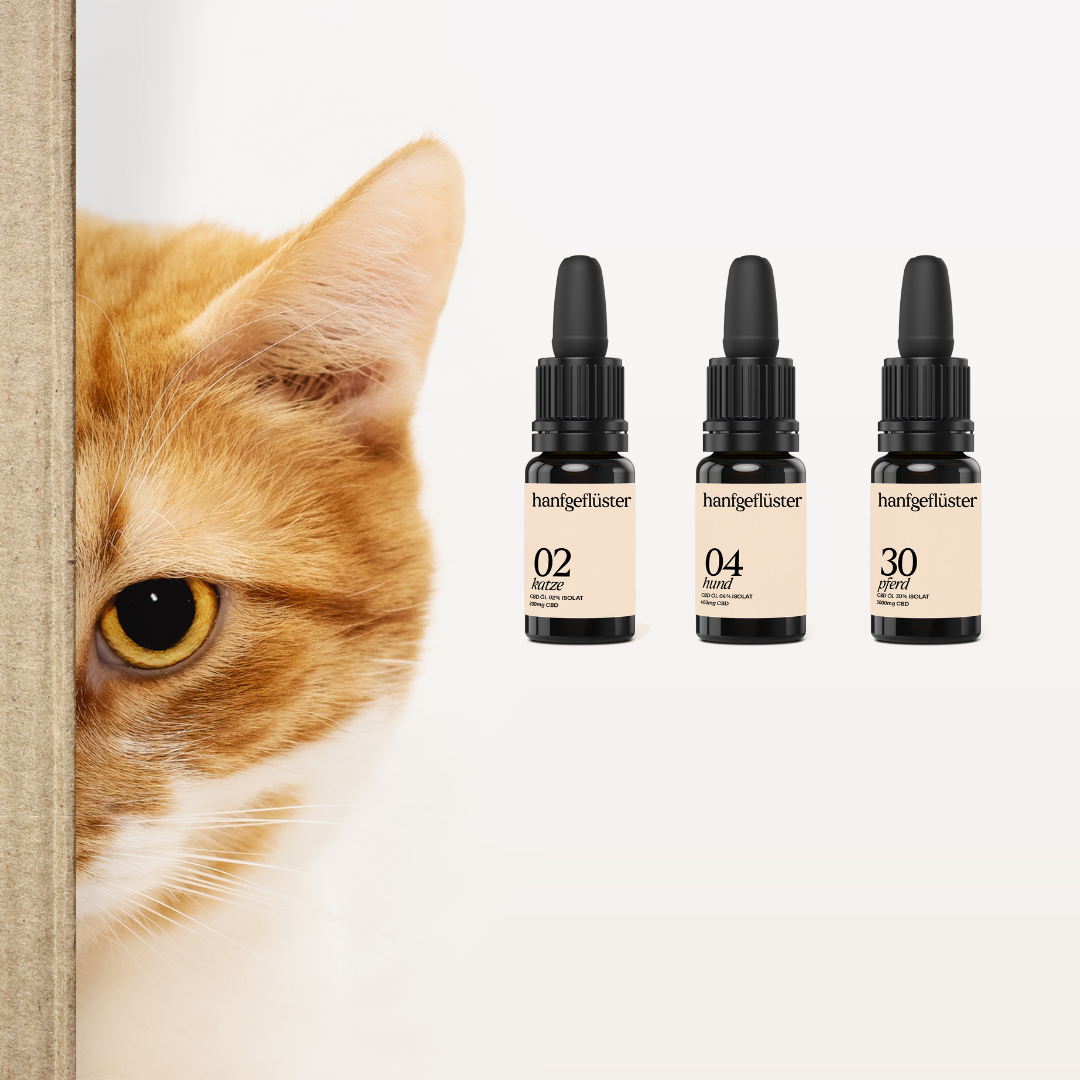
hanfgeflüster CBD Oil for Animals
One of the best-documented effects of CBD oil in animals is its ability to reduce pain and inflammation. Especially for age-related joint problems like arthritis, CBD can provide relief. (1) Researchers found that dogs with osteoarthritis treated with CBD showed a significant improvement in their mobility and quality of life. One study showed that pain and inflammatory markers in the blood were significantly reduced after just four weeks of regular CBD use.
Thunderstorms, fireworks, or separation anxiety: Many pet owners wish for a way to make certain situations more pleasant for their animals. Here, CBD oil can help through its calming effect on the central nervous system. For example, a study showed that CBD can lower cortisol levels (a stress hormone) in horses exposed to transport-related stress. (2)
For severe diseases like epilepsy, CBD oil also helps dogs, at least according to recent research findings. (3)
Important: Especially for more serious illnesses of your pet, you should definitely consult your veterinarian before giving CBD. And: CBD can only ever accompany conventional therapies and medications, never replace them!
Animals suffering from loss of appetite or digestive problems also benefit from CBD oil. Its anti-inflammatory properties help with gastrointestinal inflammation, and its appetite-stimulating effect is particularly helpful for older animals or those undergoing certain therapies (e.g., chemotherapy).
CBD-containing topicals can be used for skin problems such as itching, inflammation, or eczema. Local application can alleviate symptoms and promote healing without causing systemic side effects.
The correct dosage is crucial for the effectiveness and safety of CBD application. Generally, as with humans, start with a low dose and gradually increase until you notice that your pet is feeling better.
Animal Species |
Body Weight |
Recommended Daily Dose |
Application Notes |
|---|---|---|---|
Dog |
Small (2-10 kg) |
2-5 mg CBD |
Divide into two doses |
Dog |
Medium (10-25 kg) |
5-10 mg CBD |
Divide into two doses |
Dog |
Large (25-45 kg) |
10-20 mg CBD |
Divide into two doses |
Dog |
Very large (>45 kg) |
20-30 mg CBD |
Divide into two doses |
Cat |
All sizes |
1-2 mg CBD |
Dose carefully, more sensitive than dogs |
Horse |
Pony (130-350 kg) |
25-50 mg CBD |
Divide into two doses |
Horse |
Thoroughbred (400-700 kg) |
75-150 mg CBD |
Divide into two doses |
These are guidelines that you should always adjust individually, possibly in consultation with your veterinarian. Factors such as the animal's age, possible pre-existing health conditions, and specific areas of application influence the optimal dosage.
You should absolutely avoid administering CBD if your pet is pregnant or lactating, taking medication metabolized by the liver (ask your vet!), or has known hemp intolerances. Special caution is also advised for cats: they have a different enzyme system than dogs and humans and can react more sensitively to CBD.
For animals, it is also recommended to use a full-spectrum CBD oil to take advantage of the entourage effect. Since many animals dislike the typical hemp taste, we recommend adding the drops to food or a particularly popular treat (the liverwurst trick for dogs and cats, apples for horses). Fortunately, CBD tastes less bitter than classic medications, so some animals even get used to the taste quite quickly.
CBD products with special, natural flavors (e.g., meat flavors for dogs or cats) also help to make the administration "palatable" for your pet.
Not all CBD products are suitable for animals. However, a general rule is: Never simply use your personal CBD product for your pet!
In addition, you should consider the following points when choosing a CBD product:
0% THC content
Preferably organic cultivation methods without pesticides and heavy metals
Laboratory-tested quality with certificate
Animal-appropriate formulation and taste
Easy to dose (e.g., as drops)
At Hanfgeflüster, you get CBD products specifically developed for animals, so you can be sure that these criteria are met and that they are tailored to the special needs of dogs, cats, and horses.
Only use CBD products specifically for animals
Only use CBD products that have been specifically developed for animals – they are THC-free and contain no harmful additives.
The legal situation of CBD for animals in Germany is not yet fully clarified. CBD products for animals are in a grey area between dietary supplements and veterinary medicinal products. Pet owners may use CBD to support their animals' well-being, but should always consult with their veterinarian, especially if the animal is already receiving other medications.
CBD oil - just like for humans - can be a great way to improve your pet's well-being and alleviate discomfort. And it's all natural with very few, mild side effects. CBD can accompany many therapies and, in some cases, even represent a real alternative. Science now also confirms the positive effects of CBD in the veterinary field.
Since CBD is not classified as a veterinary medicinal product, it is also up to you: choose the appropriate dosage for your pet, educate yourself on smart application, and consult with your veterinarian if necessary – especially if your pet is already taking other medications. Observe carefully how your furry friend is doing and adjust the dosage if needed.
Our customers' opinions:
"The products are of super quality and the team is nice and helpful. I've been using the face cream for 2 years, and my skin is finally doing well again, especially in winter. And my dogs get the oil. Both my face and my animals are super happy!"
"My cat gets the CBD oil from Hanfgeflüster. Since then, he is significantly more active and happier and he is less easily startled. I would definitely recommend the product and buy it again and again ☺️"
"Fast delivery. Product was well packaged and arrived undamaged. The CBD oil for animals works very well for our cats. They take it best with treats. Our feeling is that the cats are much more relaxed. 👍"
Hanfgeflüster CBD Oil for Animals
Sources and Studies
(1) Patikorn C., Nerapusee O., Soontornvipart K., Lawonyawut K., Musikpodok K., Waleethanaphan K., Anantachoti P. (2023). Efficacy and safety of cannabidiol for the treatment of canine osteoarthritis: a systematic review and meta-analysis of animal intervention studies. Front Vet Sci. 2023 Sep 15;10:1248417.
(2) Eichler, F., Poźniak, B., Machnik, M., Schenk, I., Wingender, A., Baudisch, N., Thevis, M., Bäumer, W., Lischer, C., & Ehrle, A. (2023). Pharmacokinetic modelling of orally administered cannabidiol and implications for medication control in horses. Frontiers in veterinary science, 10, 1234551.
(3) Potschka, H., Bhatti, S. F. M., Tipold, A., & McGrath, S. (2022). Cannabidiol in canine epilepsy. Veterinary journal (London, England : 1997), 290, 105913.


